Exploring New York’s Fountains: Hidden Histories Revealed
“Fountains represent much more than mere ornamental structures,” stated Stephanie Azzarone, a 72-year-old New Yorker with a passion for history.
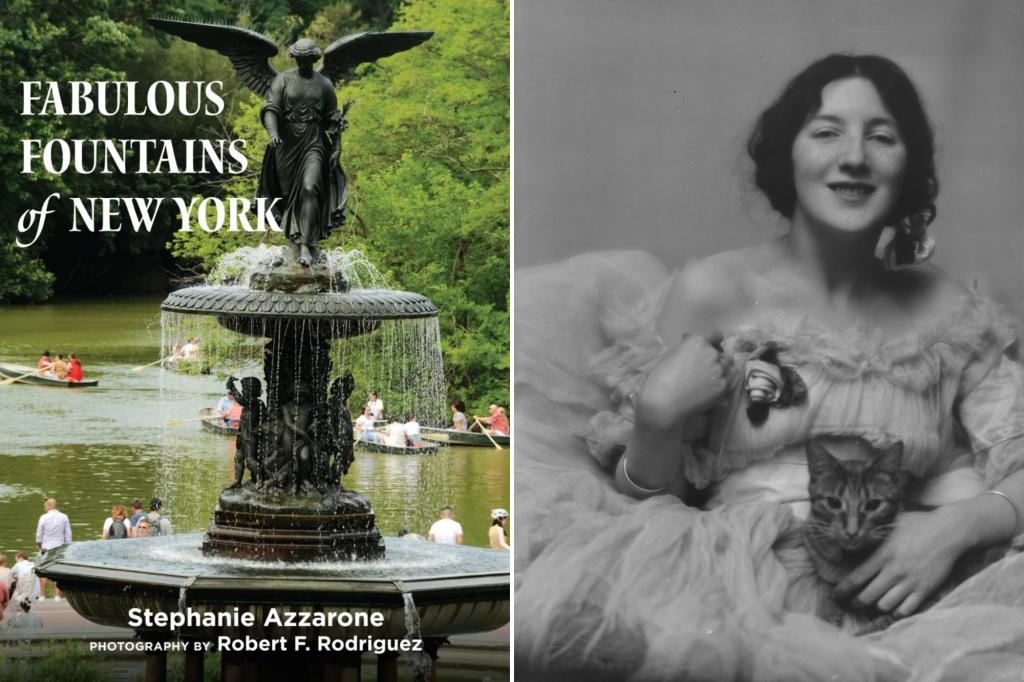
In her upcoming book, Fabulous Fountains of New York (Empire State Editions, releasing Sept. 2), Azzarone delves into the city’s stunning fountains while unearthing the intriguing and, at times, scandalous stories associated with them.
She points out how some fountains were originally designed to quench the thirst of horses, while others served the purpose of encouraging the city’s residents to drink water rather than alcohol.
“The city hoped to steer people towards water instead,” Azzarone chuckled, referencing her collaboration with her husband, photographer Robert F. Rodriguez, also 72.
Having resided in the Upper West Side for over 40 years, the couple has a deep appreciation for its history, including its many water features.
“There’s something incredibly soothing about watching water flow from a fountain,” she remarked.
Azzarone shares the intriguing stories behind five noteworthy fountains:
Robert Ray Hamilton Fountain, Riverside Park at 76th Street
This fountain, funded by Robert Ray Hamilton—great-grandson of Alexander Hamilton and a member of the New York State Assembly—faced construction delays due to a scandal that marred his reputation.
He was romantically involved with Evangeline Steele, who falsely claimed pregnancy to coerce him into marriage. Months before their wedding, Steele returned from a visit to her mother, claiming to have a child that she actually purchased illegally.
Disenchanted with her antics, Hamilton sought a divorce. In a moment of rage, Steele attacked the nurse caring for their supposed child and was arrested. Hamilton subsequently fled to Wyoming, where he drowned in the Snake River in 1890. It wasn’t until 1906 that his elegant fountain, adorned with an eagle, was finally realized.
“It’s one of my favorites in the city because of the scandalous story behind it,” Azzarone noted.
Fireman’s Memorial, Riverside Park and 100th Street
Constructed in 1913, this striking rectangular monument with a bronze plaque honors fallen firefighters. Azzarone reveals that the model for its sculptures, Audrey Munson, had a remarkable but tragic narrative.
Celebrated as the “American Venus,” Munson posed for multiple monuments throughout the city during her lifetime. However, her life took a dark turn when the owner of her boarding house, Dr. Walter Wilkins, murdered his wife to pursue a relationship with her. Eventually, Munson was committed to a psychiatric hospital at age 40, where she remained until she passed away at 104.
Bethesda Fountain, Central Park at 72nd Street
Renowned for its majestic Angel of Water, Bethesda Fountain was established in 1873 and has appeared in numerous films, including Hair, Gotham, and Godspell.
The sculpture was created by Emma Stebbins, the first woman in New York to be commissioned for a major public artwork, drawing inspiration from her lover, actress Charlotte Cushman. Interestingly, Stebbins portrayed her angel as female, which was unconventional for her time.
Although celebrated, the statue faced criticism upon its unveiling, with one critic dismissing it as a “feebly-pretty idealess thing.” Stebbins passed away in 1882 at 67 from lung-related issues, likely worsened by years of breathing marble dust.
Lowell Fountain, Bryant Park (near 41st Street and Sixth Avenue)
An iconic fixture in Bryant Park since 1912, the Lowell Fountain serves as the first major monument in the city honoring a woman: social reformer Josephine Shaw Lowell.
While pregnant with her late husband’s child, Lowell wore mourning attire for the remainder of her life following his death in the Civil War. She later emerged as a prominent activist in the city.
“The fountain is constructed to prevent cracking in summer, often culminating in unique icicle formations,” Azzarone explained. “It resembles a towering angel or a fantastical creature.”
Pulitzer Fountain, Grand Army Plaza at E. 59th St and Central Park
Joseph Pulitzer, the notable newspaper publisher, funded this fountain before his passing in 1911. It was inaugurated in 1916, but its sculptor, Karl Bitter, tragically died in a car accident the previous year.
The fountain showcases the Roman goddess of Pomona holding a basket of fruits, a design that infuriated Alice Vanderbilt, residing directly across the street. "She disliked the view so much that she moved to a different room in her 137-room mansion," Azzarone explained.

Passionate journalist and digital news editor with a keen eye for global affairs and emerging trends. As the founder and lead writer of RSS News US, he is dedicated to delivering accurate, insightful, and engaging content to readers seeking trustworthy news in a fast-paced world.