
Rare Discovery: Orange Shark Makes Waves in Costa Rica
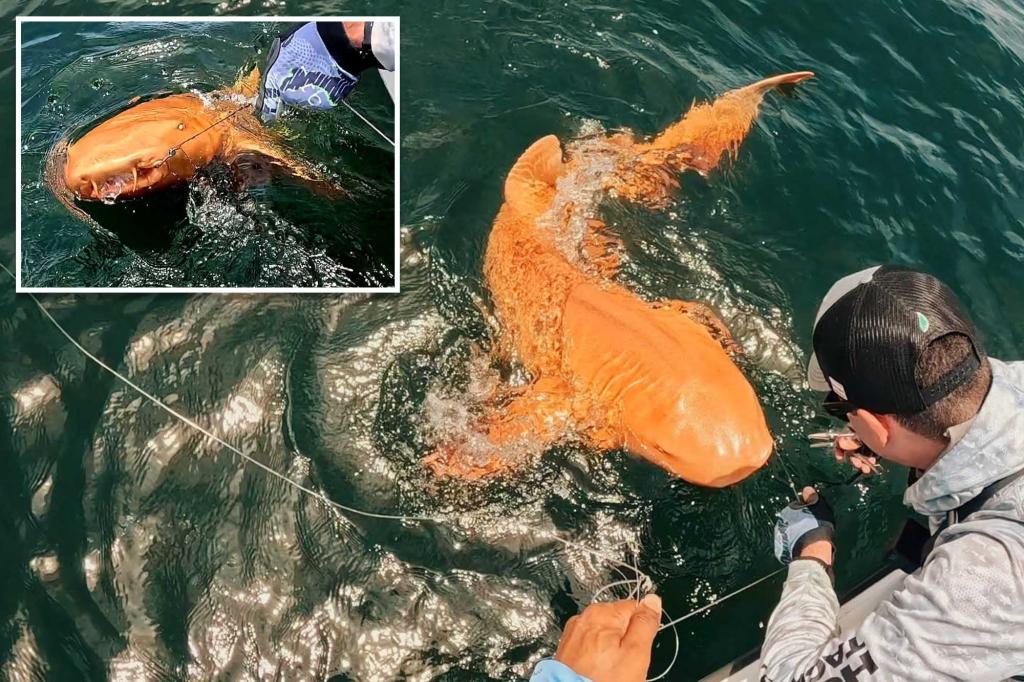
Scientists recently encountered an extraordinary orange shark in the wild, distinguished by its creamsicle-colored skin, which results from two uncommon genetic traits known to affect deep-sea predators.
This unprecedented finding occurred during a fishing expedition in Costa Rica’s Tortuguero National Park in August 2024, according to a report published in a scientific journal. The dedicated researchers managed to capture photographs of the unique specimen before promptly returning it to its natural habitat.
Experts hailed this discovery as a landmark event, marking the first documented case of an orange shark, as detailed in the Marine Biodiversity journal.
Typically found in the coastal waters of Costa Rica, this nurse shark appears to have been born with xanthism, a genetic trait that diminishes darker pigments, causing lighter shades such as orange and yellow to be more visible.
The vibrant creature resembles a giant, colorful koi fish more than a typical shark, and its rare coloration can be attributed to likely having albinism as well—another condition that reduces melanin production and often results in stark white features.
In this case, the shark’s eyes were a pale white, devoid of visible irises, as noted by the researchers.
The combined effects of xanthism and albinism have created the shark’s remarkable appearance. Scientists also mentioned that environmental elements such as inbreeding, stress, and hormonal issues might have contributed to its striking color.
Typically, nurse sharks exhibit light brown skin that helps them camouflage within their environment, accompanied by dark, beady eyes surrounded by a white cornea.
Despite its conspicuous coloration, this orange shark has remarkably reached adulthood, defying the odds against predation.
Notably, nurse sharks possess small, pointed teeth and rely on suction to capture prey, unlike many other types of sharks that are equipped with sharp jaws.
Researchers do not anticipate that these genetic anomalies will affect the shark’s life expectancy, particularly since it has already reached adulthood without the necessary camouflage.
While albinism is infrequently seen in sharks, instances have been observed in various other species, both terrestrial and aquatic.
In a related incident, an Iowa family spotted two albino deer while celebrating their son’s 13th birthday; initially mistaking them for llamas, they later noted that normal-colored deer were accompanying the duo.
Additionally, an animal sanctuary in Australia recently took in a group of albino kangaroos that nearly matched the number of their normally pigmented counterparts, who appeared unfazed by the differences.

Passionate journalist and digital news editor with a keen eye for global affairs and emerging trends. As the founder and lead writer of RSS News US, he is dedicated to delivering accurate, insightful, and engaging content to readers seeking trustworthy news in a fast-paced world.