New Insight into Possible Saudi Government Ties to 9/11 Hijackers
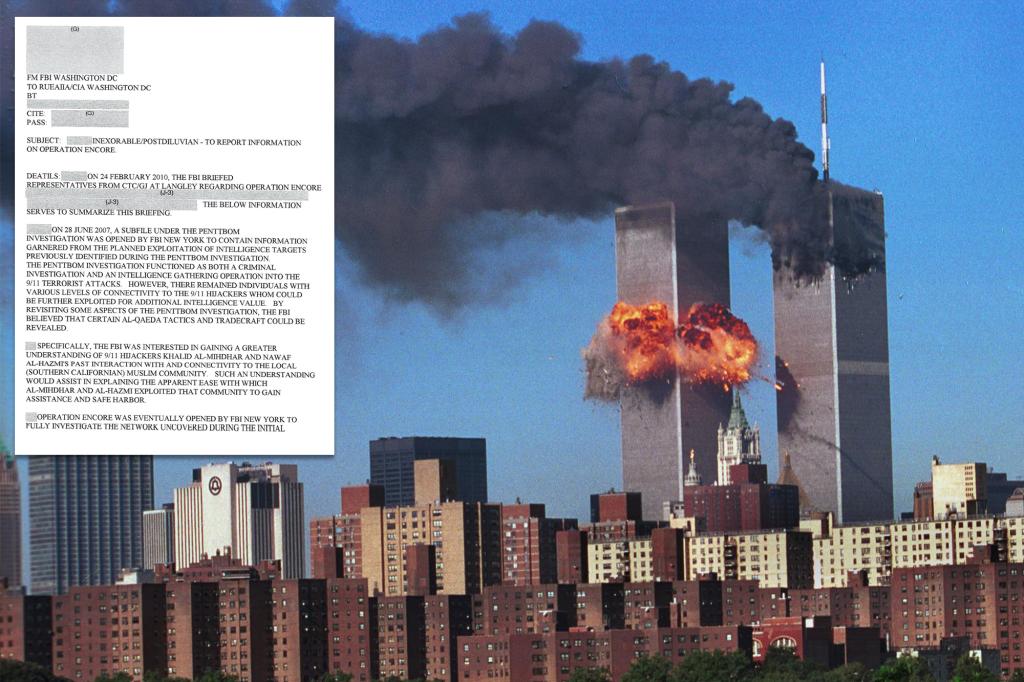
WASHINGTON — Newly released intelligence documents and insights from former national security officials indicate that employees of the Saudi Arabian government might have functioned as an "advance team" for the Al Qaeda operatives responsible for commandeering four planes on September 11, 2001, resulting in the deaths of nearly 3,000 Americans.
A probe by the FBI, originating from its New York Field Office, revealed that two officials from Riyadh — Mutaib al Sudairy and Adel Mohammad al Sadhan — maintained a "past connection" to the hijackers, along with individuals who aided them, as noted in a declassified memo dated September 28, 2010.
Evidence suggests that the preparations began years prior to the arrival of two of the hijackers—Nawaf al-Hazmi and Khalid al-Mihdhar—who reached Los Angeles on January 15, 2000. Their associates reportedly arranged for their accommodation, sustenance, and facilitated contacts as the groundwork for the plots took shape.
Documentation from Operation Encore—initially highlighted by independent journalist Catherine Herridge—reveals the extent of Al Qaeda’s efforts to train the hijackers and lay plans against the U.S. as early as December 1998, coinciding with al Sadhan’s first brief visit to Southern California.
Since 2002, relatives of the 9/11 victims have sought legal recourse against the Kingdom of Saudi Arabia in federal court, asserting the country’s complicity in the attacks. Recently, a Manhattan judge permitted their case to progress to trial, backed by new "circumstantial evidence."
Following al Sadhan’s 1998 visit, he accompanied al Sudairy to Washington, D.C., in June 1999 before traveling to San Diego, where he resided for six weeks with Omar al-Bayoumi—a Saudi student deemed by the FBI to be an intelligence operative for Riyadh.
Fahad al-Thumairy, an imam at the King Fahad Mosque in Culver City, was identified as a "contact" for al Sadhan during that Los Angeles visit and later extended support to Al-Hazmi and Al-Mihdhar, both of whom were involved in hijacking American Airlines Flight 77, which was crashed into the Pentagon on 9/11. Al-Thumairy’s placement at the mosque was coordinated by Musaed al-Jarrah, who oversaw Islamic affairs at the Saudi embassy in Washington.
Footage from the 1999 D.C. visit displayed al Sadhan and al Sudairy recording landmarks like the U.S. Capitol and the White House, which were considered potential targets for United Airlines Flight 93, which went down in Shanksville, Pennsylvania, after passengers attempted to reclaim control of the plane.
While in Southern California, al-Bayoumi "provided housing and support" to the Saudi officials, according to the FBI records, at the same San Diego address where al-Hazmi and al-Mihdhar would later stay near the Al-Ribat mosque. Anwar al-Awlaki, the mosque’s imam and a dual citizen of the U.S. and Yemen, was involved with Al Qaeda until he was killed in a drone strike in Yemen in 2011.
A subsequent FBI document cited a source claiming there was a "50/50 chance" that Al-Bayoumi possessed “prior knowledge” of the 9/11 plans.
In 2000, al Sadhan and al Sudairy relocated to Lawrence, Kansas, and Columbia, Missouri, respectively, with the latter enrolling in an intensive English program at the University of Missouri under the guise of language acquisition. Both returned to Saudi Arabia in October 2001.
The FBI’s findings included previously undisclosed phone records, financial data, and various interviews. The CIA received a briefing on these developments in February 2010, three years post the initiation of Operation Encore.
The investigation, a branch of the FBI’s PENTTBOM probe—the bureau’s largest investigation—revealed previously unreleased recordings of a “welcome party” in California for some of the hijackers,which included another Saudi government official.
Former Director of the National Counterintelligence and Security Center Bill Evanina remarked that these documents could provide "new investigative leads" for both the FBI and CIA to better understand the circumstances surrounding the attacks. He noted the ambiguity regarding whether the Saudi officials were acting on the behalf of their government or were serving Al Qaeda’s interests.
Evanina emphasized the importance of these records, which should have been presented to the 9/11 Commission, as U.S. intelligence already possessed footage of the Saudis’ visits by fall 2001.
Philip Zelikow, who served as the executive director of the 9/11 Commission, stated he could not recall seeing the complete 30-minute video of the hijackers’ welcome party. He maintained that the conclusions in their report, despite uncertainties, were largely consistent with their findings regarding several suspects potentially linked to a clandestine support network in the U.S.
A spokesperson for the Embassy of Saudi Arabia stated their respectful disagreement with Judge George Daniels’ recent ruling and affirmed that they possess valid grounds for appeal. The representative outright rejected any implications of the Saudi government’s involvement in prior arrangements for the 9/11 attacks.
As of now, the CIA and FBI have not issued responses to inquiries concerning these revelations.
Passionate journalist and digital news editor with a keen eye for global affairs and emerging trends. As the founder and lead writer of RSS News US, he is dedicated to delivering accurate, insightful, and engaging content to readers seeking trustworthy news in a fast-paced world.